“All sorts of things can happen when you’re open to new ideas and playing around with things.”
– Stephanie Louise Kwolek
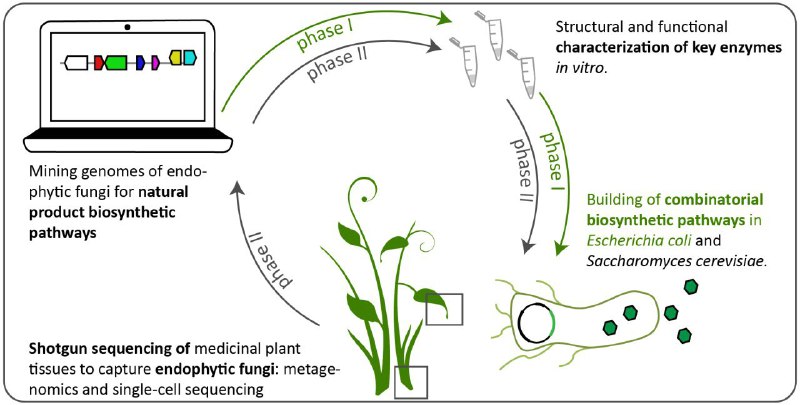
Research in the Haslinger lab at the University of Groningen focuses on the understanding and engineering of biosynthetic pathways in plants and microbes. Our goal is to engineer microbial cell factories to produce natural products with pharmaceutical applications. The three main lines of research are (1) the de novo genome sequencing of microbes inhabiting medicinal plants; (2) the computational mining of genome sequences for biosynthetic enzymes and pathways; and (3) the design and engineering of recombinant pathways in model organisms such as Escherichia coli.

We strive to generate greener sources for fine chemicals and pharmaceuticals and contribute to building a sustainable bio-based economy. Sustainability is not only the main motivator for our research but also the framework for how we perform our research. As scientists we minimize our greenhouse gas emissions and our environmental footprint by conserving water and energy, minimizing the use of single-use plastics and adhering to the principles of green chemistry.
The Haslinger lab aims to provide an inclusive and supportive environment for creative thinking and personal growth. We build upon each other’s strengths to achieve our goals and engage in the process each step along the way.

Genome sequencing.
We are interested in the internal microbiomes of medicinal plants, the so-called endophytic microbial communities. We study the composition of these communities in the context of the plant habitat; as well as the genomes of individual members of the community in order to explore their potential for secondary metabolite production.
Genome mining.
We are interested in identifying genes and pathways that can be used for in vitro enzymatic cascades and recombinant microbial cell factories. We explore computational approaches to pre-select candidates based on sequence motifs and genomic context in order to reduce the number of candidates for experimental screening while covering a wide sequence space.


Pathway engineering.
We strive to generate recombinant biosynthetic pathways for a more sustainable production of nutraceuticals, pharmaceuticals and fine chemicals. We develop and employ in vitro prototyping workflows to minimize the experimental workload and the use of resources such as growth media, chemicals and solvents for greener lab practices.
Open projects for MSc students
Tackling fungal infections at their roots – developing precision drugs acting on the packaging of DNA (NWO funded project)
Severe fungal infections affect 1.5% of the Dutch population annually. One tenth of these cases is caused by (multi-)drug resistant fungi. The low survival rate among these patients (less than 50%) urgently calls for the development of new antifungal drugs. In this project we aim to target a very fundamental process governing the transition to a pathogenic lifestyle in fungi, namely changes in the packaging of DNA. We will develop new, highly specific chemical inhibitors that target key players in this process with high precision. This research will open the door for the development of new antifungal drugs.
I am looking for one MSc students to continue this project starting in the fall/winter of 2024. The student should be interested in protein expression, purification, and essay development for inhibitor screening.
Secondary metabolites from filamentous fungi (supported by the Gratama Foundation)
Filamentous fungi are well-known producers of bioactive secondary metabolites with applications in agriculture, food preservation and healthcare. In the Haslinger Lab, we have an in-house strain collection of filamentous fungi that is currently being screened for secondary metabolites with antimicrobial activities. In this project, a high-throughput screen will be established to investiagte all isolates in the collection. Once interesting strains are identified, the relevant compounds will be isolated and characterized.
New biocatalysts from the fungal kingdom (supported by NWO Vidi grant)
New genome sequences are being generated at an unprecedented rate, allowing us to take a look into the biosynthetic potential of previously understudied organisms. In the Haslinger Lab, we mine fungal genomes in public databases and in our in-house strain collection for interesting biosynthetic genes and gene clusters. The aim of this project is to heterologously express fungal enzymes and characterize their potential for applications as biocatalysts in combinatorial pathways.
Our funding sources

several grants 2022, 2023, and 2024
Excellence Award 2021 from the
Federation of European
Biochemical Societies (K. Haslinger)
start-up fund 2020,
FSE research grant 2022 (K. Haslinger)

personal fellowship (K. Haslinger)
H2020-MSCA-IF-2019 893122

personal fellowships (Ting He, Bo Peng, Xiao Li, Ziwei Wang)

Gratama Stichting (K. Haslinger, 2024)
Get in touch
Dr. Kristina Haslinger
Chemical and
Pharmaceutical Biology
 Haslinger Lab